
Shopify's WordPress Plugin: Progress, But Still Missing the Point
Shopify recently announced their WordPress plugin, allowing businesses to add Shopify products to WordPress sites. This move reveals something important: Shopify knows they have a serious SEO problem. WordPress has always been better at achieving baseline SEO—better content management, cleaner URLs, more flexible site architecture, and search engines simply trust WordPress sites more. By creating this plugin, Shopify is essentially admitting their platform can't compete with WordPress when it comes to organic search visibility.
On the surface, it sounds like a win—WordPress content management paired with Shopify's powerful e-commerce engine. The promise is simple: install the plugin, connect your Shopify store, and start selling.
But here's the problem they're not telling you: You're still completely dependent on Shopify.
Sure, you can manage your content in WordPress now. That's an improvement over being forced to use Shopify's limited blogging and page-building tools. But the fundamental issue remains—your entire e-commerce operation, customer data, and business logic are still trapped inside Shopify's ecosystem.
What happens when:
- Shopify raises their monthly fees (again)?
- You need features Shopify doesn't offer?
- Your business outgrows Shopify's limitations?
- You want to switch to WooCommerce or another platform?
Answer: You start rebuilding everything from scratch. Again.
The Platform Dependency Trap
Let's be clear about what Shopify's WordPress plugin really is: it's a prettier version of the same old single-vendor dependency.
You might have WordPress handling your content, but Shopify still controls:
- Your product catalog
- Your customer database
- Your checkout experience
- Your transaction processing
- Your inventory management
- Your business data
And when you decide (not if, but when) that you need a different backend, you'll discover the painful truth: none of your front-end implementation works anymore. Every product display, every cart interaction, every checkout flow—all of it needs to be rebuilt for your new platform.
This isn't flexibility. It's single-vendor dependency with a WordPress facade.
Why Businesses Are Choosing Platform-Agnostic Solutions
The enterprise world learned this lesson years ago: single-vendor dependency is expensive, risky, and limiting.
Modern businesses need:
1. True Platform Freedom
The ability to switch between e-commerce platforms (Shopify, WooCommerce, Medusa, Contentful Commerce) without rebuilding your entire website.
2. Business Logic Ownership
Your cart functionality, checkout flows, and business rules should be yours—not tied to a specific vendor's implementation.
3. Data Portability
Customer information, order history, and business intelligence should be accessible and movable without vendor-specific export processes.
4. Cost Control
When your infrastructure supports multiple backends, vendors compete for your business. Single-vendor dependency means they own you, and pricing reflects that reality.
5. Technical Flexibility
Your development team should be able to extend and customize without being constrained by platform limitations.
Enter Araptus Highlander: The Platform-Agnostic Solution
While Shopify is celebrating their "integration" with WordPress, we've been solving the actual problem: building a managed ecosystem that works with any backend.
Araptus Highlander is an enterprise-grade web framework that provides true platform independence. Not just for content management, but for your entire digital operation—e-commerce, content, authentication, and business logic.
How Highlander Actually Solves the Problem
Unified E-Commerce API
Instead of writing code specifically for Shopify (or WooCommerce, or Medusa), Highlander provides a single, unified interface that works with any platform.
// Your code stays the same regardless of platform
import { getAllProducts, addToCart } from '../utils/ecommerce';

// Works with Shopify today
const products = await getAllProducts();

// Works with WooCommerce tomorrow (just change config)
// Same code, different platform
Need to connect Shopify and WooCommerce? The ecosystem handles both through a unified integration layer. One configuration, every commerce platform.
Modular CMS Integration
Highlander doesn't just integrate with WordPress—it provides the same unified approach for any CMS platform:
- WordPress
- Contentful
- Strapi
- Local file-based content
Same component code, different backend. Real platform freedom.
Complete Business Features
Unlike Shopify's plugin (which only handles products and checkout), Highlander provides everything modern businesses need:
- Multi-language Support: 15+ languages with proper i18n architecture
- Enterprise Security: Multi-layer security with real-time threat detection
- Advanced SEO: Comprehensive structured data and optimization
- Location-Based Landing Pages: Dynamic geographic targeting
- Integrated Analytics: Complete business intelligence
- Newsletter & Email Marketing: Built-in customer communication
- Testimonial Systems: Social proof without third-party plugins
The Real-World Difference
Let's compare what happens when business needs change:
Scenario: You Need to Switch E-Commerce Platforms
With Shopify's WordPress Plugin:
- ❌ Rebuild all product displays
- ❌ Recreate cart functionality
- ❌ Rebuild checkout flows
- ❌ Migrate customer data manually
- ❌ Rewrite all e-commerce integrations
- ❌ Test everything from scratch
- ⏱️ Timeline: 2-4 months of development
With Araptus Highlander:
- ✅ Change config:
type: "woocommerce" - ✅ Update environment variables
- ✅ Test checkout flow
- ⏱️ Timeline: Same day
The difference isn't just technical—it's strategic business agility.
Beyond E-Commerce: Complete Digital Infrastructure
Here's where Shopify's WordPress plugin really shows its limitations: it only solves one problem (adding Shopify products to WordPress).
Modern businesses need comprehensive digital infrastructure:
Araptus Highlander Provides:
TypeScript Web Framework Foundation
- Type safety prevents entire classes of bugs
- IDE support and intelligent autocomplete
- Compile-time validation
- Enterprise-grade code quality
Astro-Based Development Core
- Fast by default — optimized at the architecture level
- Optimal performance by default
- Modern development experience
- Island architecture for efficiency
Modular Architecture
- Add features as you need them
- No bloated all-in-one solutions
- Easy to maintain and extend
- Proven in production environments
Managed Ecosystem Architecture
- Connect any backend through unified configuration
- Managed infrastructure handles platform complexity
- Maintain full operational control
- Future-proof your investment
The Enterprise Advantage
Shopify's target market is small businesses who don't know better yet. Their WordPress plugin is designed for people who think "integration" means "plugin installation."
Araptus Highlander is built for businesses that understand the real costs of single-vendor dependency:
For Growing Companies
You don't rebuild your website every time you outgrow a platform. You change your configuration and keep moving forward.
For Development Teams
Your developers write code once, using modern frameworks and best practices. Platform changes don't mean throwing away months of work.
For Business Owners
You make platform decisions based on business needs, not technical limitations. If Shopify raises prices or WooCommerce offers better features, you have real choices.
For Stakeholders
Your digital infrastructure is an asset, not a liability tied to a specific vendor's ecosystem.
Technical Excellence vs. Marketing Solutions
Shopify's WordPress plugin is a marketing solution—it solves Shopify's problem (limited content management) while deepening platform dependency.
Araptus Highlander is a technical solution—it solves the actual business problem of vendor dependency through proper architectural design.
What Real Platform Agnostic Means:
Unified Interfaces
Every platform adapter implements the same interface. Your application code doesn't care whether products come from Shopify, WooCommerce, or Contentful.
Factory Pattern Implementation
The system automatically loads the correct adapter based on your configuration. No manual switching, no code changes, no vendor-specific logic in your application.
Consistent User Experience
Your customers get the same excellent experience regardless of which backend platform you're using. Platform changes are invisible to them.
Developer Experience
Your development team works with modern TypeScript, clear interfaces, and comprehensive documentation—not vendor-specific APIs and limitations.
The Cost of "Free" Integrations
Shopify's WordPress plugin is free. That should be your first warning sign.
They're not giving you value—they're deepening your dependency. Once you've built your site around their plugin, you're paying:
- Monthly Shopify fees (starting at $39, scaling to hundreds)
- Transaction fees (2.9% + 30¢ per transaction on Basic plan)
- App marketplace fees (for features that should be built-in)
- Theme costs (because Shopify's default options are limited)
- Developer costs (every customization fights against Shopify's constraints)
And when you eventually need to leave? Rebuild costs that dwarf anything you "saved" on the free plugin.
Araptus Highlander's Transparent Value:
You pay for what you actually need:
- Your choice of hosting (Vercel, Netlify, or any platform)
- Your choice of e-commerce backend (use free WooCommerce if budget is tight)
- Your choice of CMS (even free options like WordPress.com or local files)
- Your choice of payment processing (Stripe, PayPal, etc.)
The managed ecosystem doesn't tie you to any vendor's pricing structure. Your costs are transparent, predictable, and under your control.
Real Client Success: Evolving With the Ecosystem
We've seen businesses successfully evolve their backend multiple times as their needs changed:
Startup Phase: Local file-based content + WooCommerce (minimal costs)
↓
Growth Phase: WordPress + Shopify (better inventory management)
↓
Enterprise Phase: Contentful + Custom solution (complete control)
Total rebuilding required with Highlander: Zero.
The same business using traditional approach or Shopify's plugin: Three complete rebuilds, thousands in development costs, months of downtime.
The Future of Web Development
The Shopify WordPress plugin represents old thinking: platform integration as a solution.
Araptus Highlander represents the future: platform abstraction as architecture.
As businesses become more sophisticated about digital infrastructure, they're demanding managed ecosystems over monolithic platforms. The question isn't "which platform should we commit to forever?" but "how do we maintain flexibility while building great experiences?"
Why Platform Agnostic Matters More Than Ever:
- Rapid Technology Changes: New platforms and solutions emerge constantly
- Business Model Evolution: Your needs today won't match your needs in 2 years
- Competitive Pressure: Agility is a competitive advantage
- Cost Optimization: Negotiate from a position of freedom, not dependency
- Risk Management: Vendor stability shouldn't determine your business risk
Making the Right Choice
Shopify's WordPress plugin might seem like an easy solution. Install a plugin, connect to Shopify, start selling. Simple.
But "easy" and "right" aren't the same thing.
The easy choice creates dependency. The right choice builds a foundation that adapts.
Choose Araptus Highlander When:
- ✅ You value long-term business agility over short-term convenience
- ✅ You want managed infrastructure that adapts to your needs
- ✅ You understand that single-vendor dependency is expensive and limiting
- ✅ You need enterprise-grade features and security
- ✅ You're building for scale and future growth
- ✅ You want professional development practices and modern architecture
Choose Shopify's Plugin When:
- ⚠️ You're okay with total Shopify dependency
- ⚠️ You don't mind rebuilding if your needs change
- ⚠️ You're comfortable with Shopify controlling your business data
- ⚠️ You don't need features beyond basic e-commerce
- ⚠️ You're not concerned about long-term costs and flexibility
The Bottom Line
Shopify's WordPress plugin is progress—it acknowledges that businesses need better content management than Shopify provides. But it's a half-measure that deepens platform dependency.
Araptus Highlander is the complete solution: true platform freedom, enterprise-grade features, and the flexibility to make business decisions without technical constraints.
Your Business Deserves a Managed Ecosystem
The question isn't whether you should use Shopify's WordPress plugin. The question is whether you want to build your business on a managed ecosystem or a single-vendor dependency.
Choose the ecosystem. Choose Araptus Highlander.
Ready for a Managed Ecosystem?
See how Araptus Highlander delivers platform-agnostic excellence without compromise.
- ✅ Same-day backend changes (not months of rebuilding)
- ✅ Enterprise-grade security (multi-layer defense-in-depth)
- ✅ Fast by default (optimized at the architecture level)
- ✅ Managed infrastructure (one framework, any backend)
- ✅ Complete business features (beyond just e-commerce)
Contact our team to discuss how Araptus Highlander can future-proof your digital infrastructure with a managed ecosystem built for modern businesses.
Your business. Your data. Your ecosystem.
Experience Highlander in Action
See a live demo of what Araptus Highlander can do for your business. Click below to explore our interactive demo.
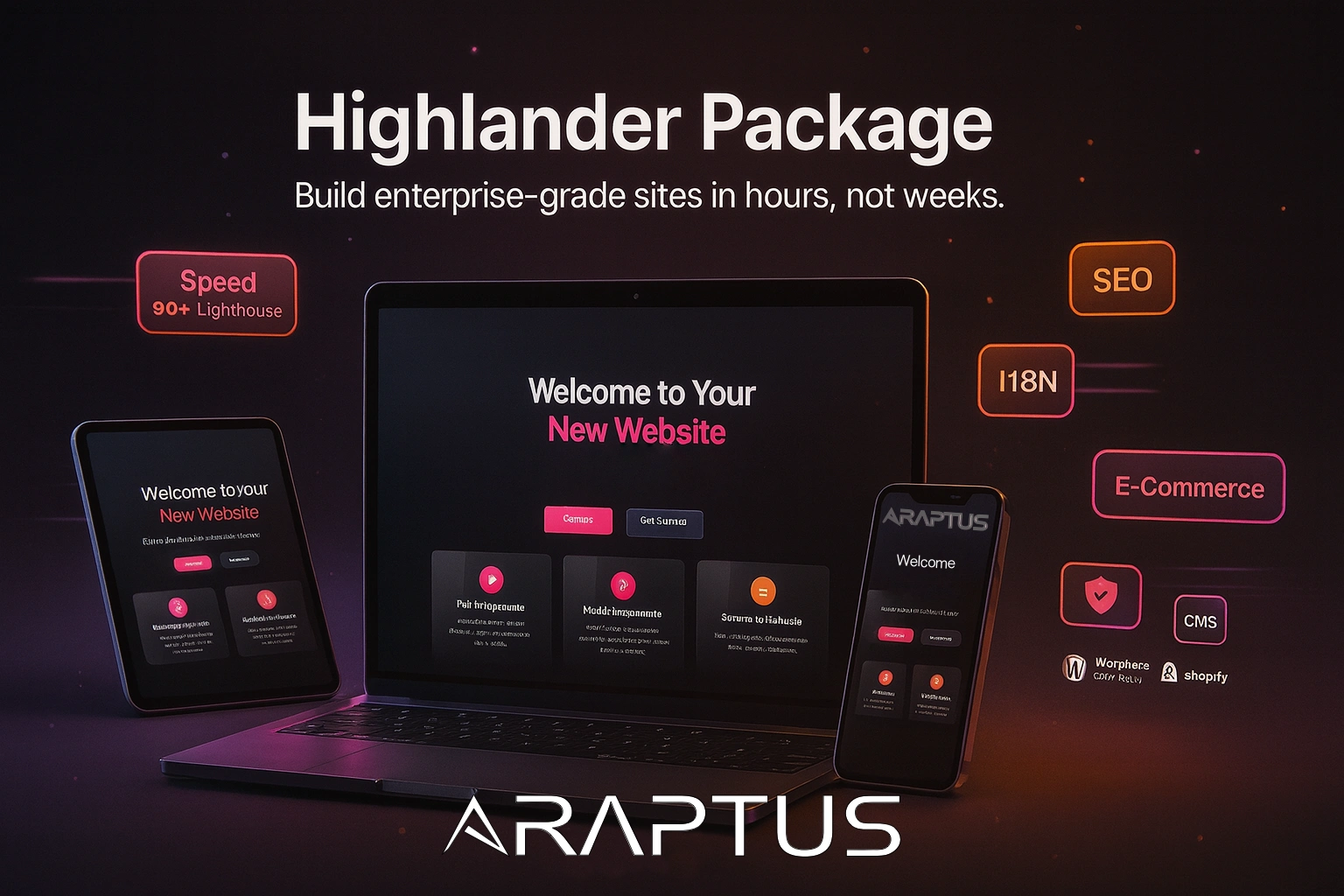
👆 Click the image above to see Highlander's capabilities firsthand
About Araptus Highlander
Araptus Highlander is an enterprise-grade web framework built on Astro 5.x with TypeScript, providing true platform-agnostic development for modern businesses. With unified APIs for CMS and e-commerce platforms, comprehensive security, and a managed ecosystem architecture, it's the framework serious developers choose when platform flexibility matters.
Learn More About HighlanderWritten by Araptus Team with 20+ years of software engineering experience. AI tools may be used for research and drafting assistance, but all content is reviewed, verified, and published by the author based on first-hand expertise.
