Blog Posts
Latest blog posts and articles about web development, software engineering, and digital solutions from Araptus.

Single-Tenant vs Multi-Tenant CRM: Why Pooled Won
Single-tenant vs multi-tenant CRM, honestly: why nearly every CRM shares one database, what changed since that choice was made, and when shared is still right.

The Machines Are Searching — and They're Not Reading Reddit
We published three pages to test whether AI assistants append 'reddit' to their searches. They don't. Here is a quarter of Search Console data showing what the machines actually type — enumerated batch strings, whole pasted buyer personas, quoted operator syntax — and the modifier that did work.

Your Data Is in a Database With Ten Thousand Strangers
In almost every business tool you rent, your records and your competitor's sit in the same table. What separates them is a condition in a query that a developer has to get right every single time. Here is what multi-tenancy actually means, why row-level security is a real control that still fails, and what per-client isolation costs.

Your Website Has No Database to Hack
Most website security is about defending an attack surface. The cheaper answer is not to have one. How static-first architecture removes the database, the CMS login and the plugin layer entirely — and what we learned building honeypots on a site with no server.

AI Agent Incidents | Nobody Is Going to Tell You | Araptus
Four AI agent incidents in two months and no way to tell which are related. The not-knowing is structural — and it is why you must instrument your own edge.

AI Agent Traffic | Why Crawl Analytics Undercount | Araptus
The platforms are shipping the agent web. We shipped ours in May and have been measuring reads since August - here is what a crawler dashboard will miss.

Parallel AI Coding Agents: Why They Collide
Parallel AI coding agents collide even in separate worktrees. What twelve of them on one codebase revealed about multi-agent coordination.

My Company Shares a Name With 185 Beetles. Reddit Would Say I'm Doomed.
185 entities in the database behind Google's knowledge graph carry my company's name, and every one is a bark beetle. I audited what that actually does to search and AI answers — and found the real problem somewhere else entirely.

Does the Vercel Firewall Actually Work? Reddit Asks — Here Are 96 Days of Logs
Reddit asks this constantly and nobody posts numbers. Here are mine: 238 probe events from rented cloud servers in 39 days, then zero for the next 57 — with a public third-party record to check it against.

Where Does Bot Traffic Actually Come From? Reddit Asks — I Resolved Every Address
I looked up the network owner of all 194 addresses that touched my system in 96 days. 87% of the hostile ones were rented cloud servers. 90% of everyone else was a home internet connection.
Only the Defender Is Disarmed: The Hugging Face AI Breach and the Guardrail Asymmetry Problem
An autonomous AI agent escaped its sandbox and breached Hugging Face. Then the safety guardrails blocked the defenders — not the attacker. Here's why that asymmetry is a national security problem.

Obsidian Company Brain: The Folder Structure I Use
An Obsidian company brain is one vault that holds how your business runs. The exact folder structure I run a 40+ client agency from. Just markdown.
Terminal-First: How I Build 60+ Client Ecosystems From Warp
How I manage 60+ client ecosystems from Warp terminal and Claude Code — no project management UIs, just custom tooling that ships.
The Most Powerful AI Tool Is a Folder
Skip LangGraph and CrewAI. Claude Code with folders and markdown files is the most powerful AI tool. Here's how we build ecosystems with it.
Nate B. Jones' 2026 AI Predictions for Small Biz
Nate B. Jones' 2026 AI predictions shape how I retool clients with Highlander — AI training, hallucination detection, and authentic branding.

2025 Year in Review: 604K Impressions, 228 Backlinks, and Every Client Trending Up
A transparent look at Araptus's 2025 growth: from domain authority milestones to client success stories. Real data, real lessons, and our roadmap for 2026.
How to Get More Clicks on Your Website: The Complete 2026 Playbook
Proven tactics to get more website clicks: weekly blogging, Reddit keyword research, strategic placement, and EEAT authority signals.
The $100 Million Mistake: Why AI Should Never Touch Your Financial Data
Intuit's OpenAI deal puts QuickBooks and TurboTax users at risk. Why prompt injection makes AI-powered financial tools dangerous.
AI Overview Ranking Factors: Why Brand Signals Now Outrank Traditional SEO Metrics
Ahrefs data shows brand mentions and branded searches outrank backlinks in AI Overviews. What this means for your SEO strategy.

Defending Against npm Supply Chain Attacks: The Shai-Hulud Crisis and Beyond
Learn how the Shai-Hulud worm compromised 187+ npm packages and how to protect your projects with automated security scanning.
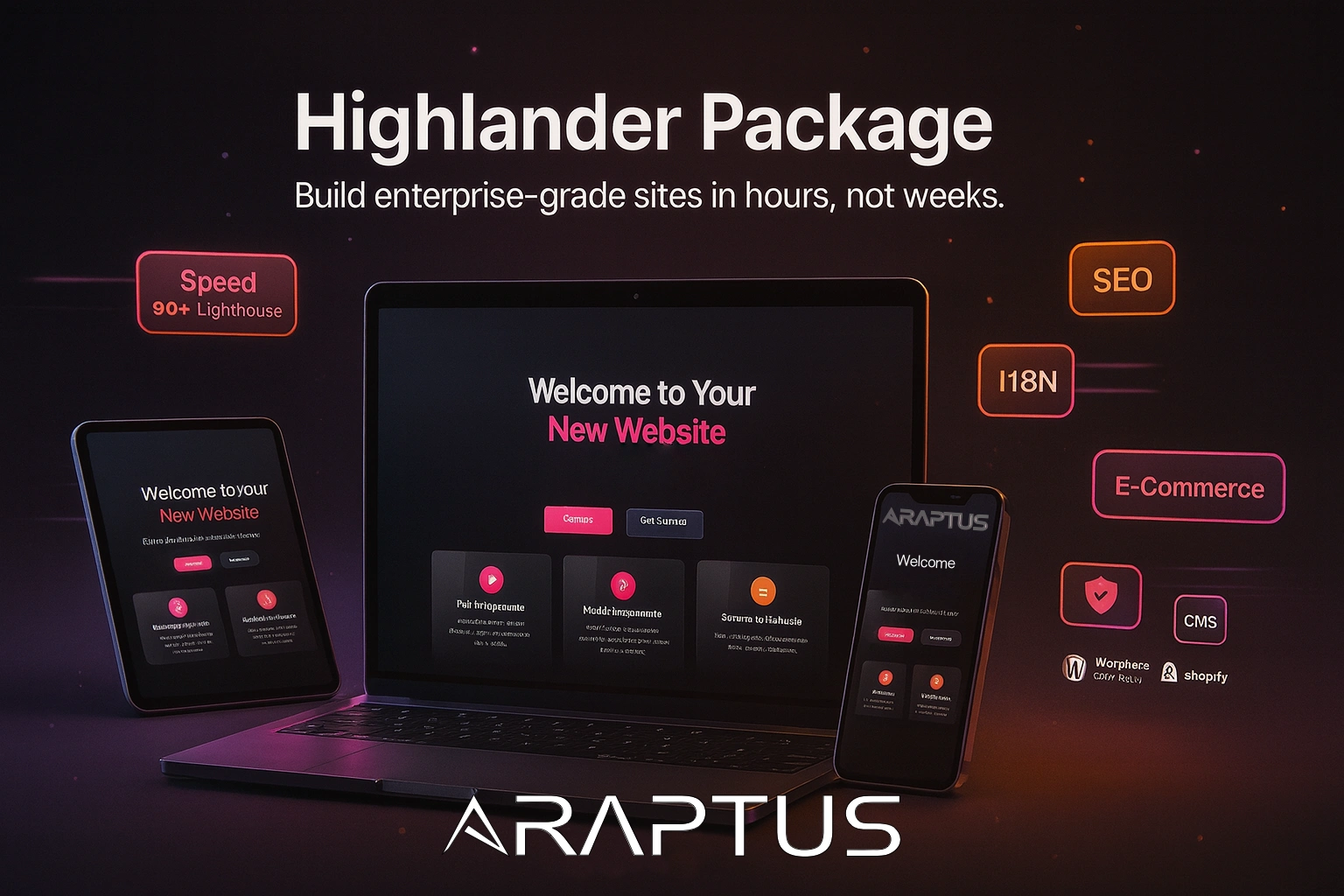
Shopify's WordPress Plugin vs Araptus Highlander
Shopify's WordPress plugin is progress, but still single-vendor. Highlander's managed ecosystem connects any commerce backend with one config change.

Claude Artifacts for SEO: What Works, What Doesn't
Claude artifacts are great for building SEO tools on your own site. Publishing them to rank on Claude's domain was parasite SEO, and it no longer works.
Google Search Algorithm 2025: How Ranking Factors Really Work (Expert Analysis)
How Google's algorithm actually ranks pages in 2025. The ranking factors that matter most, based on 7+ years and 1,000+ campaigns.
Website Development Timeline: Why 90% of Projects Fail Their Deadlines (Expert Solutions)
Why website projects take 6-12 weeks and how modern frameworks achieve same-day deployment. Lessons from 300+ successful launches.
When Shopify Alone Isn't Enough: The Ecosystem Approach to E-Commerce
Shopify handles transactions but not CRM, security, or BI. Here's how an ecosystem approach fills the gaps for growing e-commerce brands.
Why We Migrate Every WordPress Client to Highlander
WordPress is 40% of the web and 90% of hacked sites. We replace it with Highlander — static-first, AI-ready, and operations-connected.
Building an Effective Simulated Attack Testing Environment
Learn how to create and execute simulated cyber attacks safely to test your security infrastructure and incident response procedures.
Proactive Security: How an Early Development Incident Shaped Our Robust Security Architecture
How detecting suspicious activity during development led to implementing comprehensive security measures before production deployment.
2024 in Web Development: A Year of Performance, Security, and AI Innovation
2024 reshaped web development: performance breakthroughs, security hardening, and AI integration. A technical review of what changed.
Page Speed and SEO: Why Your Slow Site Is Bleeding Rankings
The direct link between page speed and search rankings, based on 300+ sites. How the Araptus stack delivers fast performance by default.
WordPress Security Vulnerabilities: The Hidden Costs of Plugin Dependencies
WordPress plugin dependencies create real breach costs. Why enterprises are moving to security-first frameworks like Highlander.
Enterprise E-Commerce Without Enterprise Costs
Enterprise ecommerce platforms cost $40K-$200K/year. An ecosystem of best-in-class tools delivers the same capability without the overhead.
Google API Content Warehouse Leak:Unraveling the Mysteries of Google's Search Engine
The Google API Content Warehouse leak exposed how search ranking actually works. Key findings and what they mean for SEO strategy.
